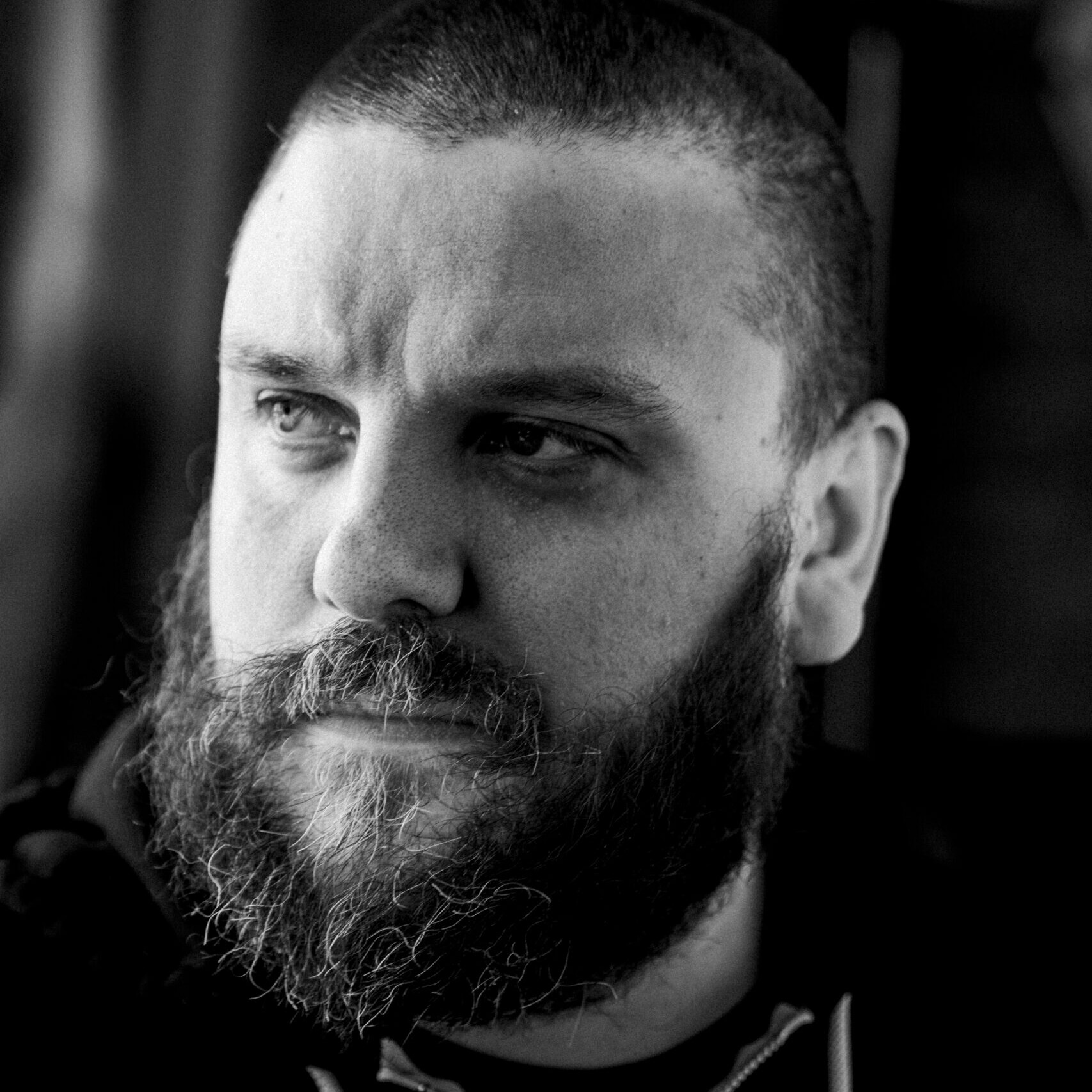
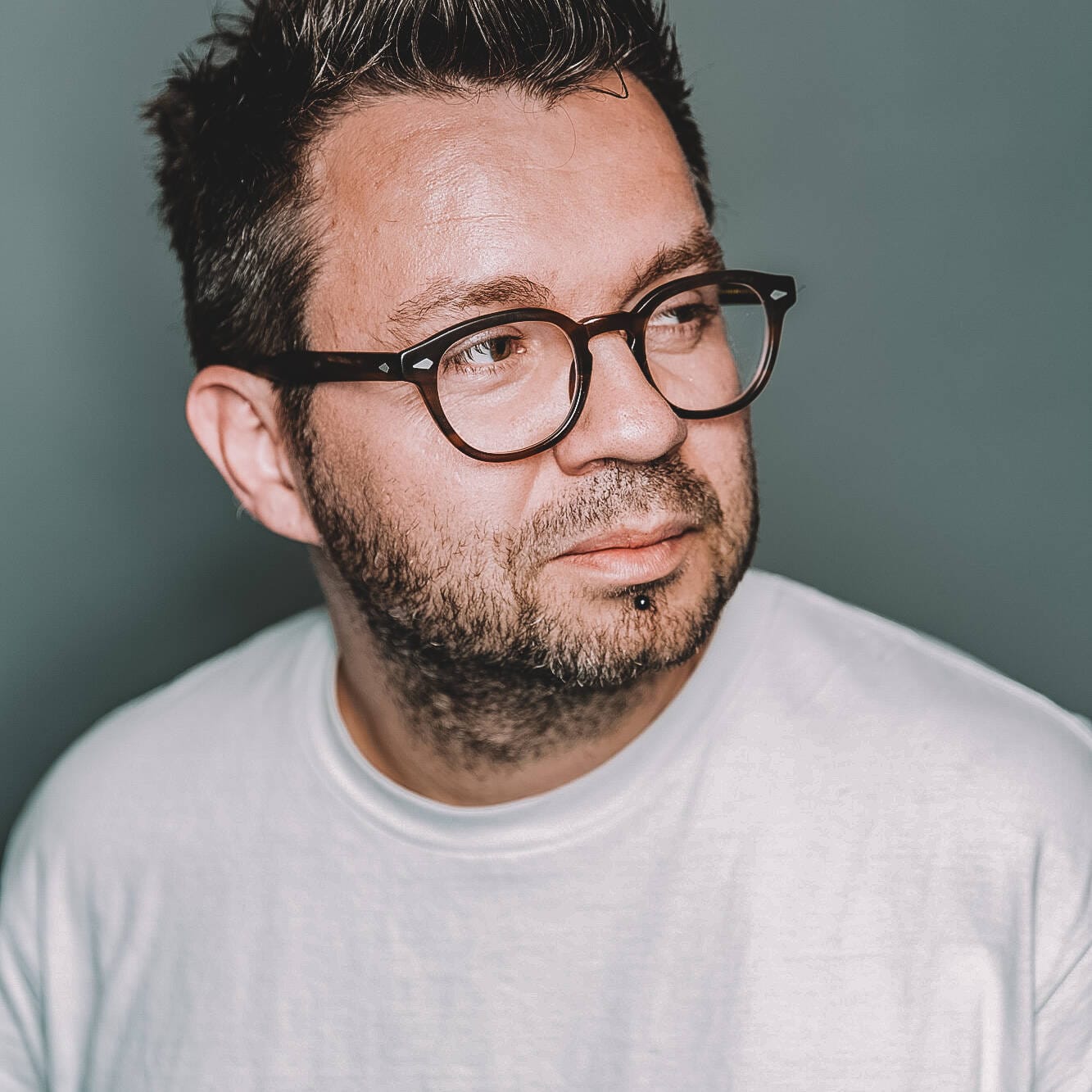
ABOUT SIMON FLÖTERSimon Flöter is a German illustrator, graphic designer and web developer from Munich, based in Amsterdam. He trained through a studio apprenticeship rather than university, built a freelance practice combining illustration, design and front-end development, and shares his illustration work on Instagram as @floter.ink.
Tune in wherever you get your podcasts /
Tune in wherever you get your podcasts /



Episode Description
For the final episode of Season 2, I didn’t want a victory lap. I wanted the truth. So my guest is Simon Flöter, a German illustrator, designer and developer living in Amsterdam, who told me early on: this is not a success story. This is from the trenches.
That sentence is why this conversation closes the season. We’ve had guests this year with big names, big exits, big followings. Simon is the other ninety percent of us. His commercial illustration work dried up this year. Money got extremely tight. He just landed a job that should carry him through the rest of the year, and he exhaled while telling me about it. If you’ve had a year like that too, this episode is yours.
No one said the word artist
Simon grew up in Munich. His parents weren’t against creativity, far from it. His mum was the one who took him to a comic book convention as a kid because he was always drawing, and that day changed something. Galleries and paintings had never done much for him. But at the convention, the artists sat there sketching, raw pencil work you could watch happening, and he was hooked.
Still, his parents came from the war generation. Their biggest fear was that there’d be no money for him, no job. So the guidance became: you’re talented, go into graphic design, something commercial. The word artist never came up. Not forbidden, just never mentioned as a thing a person could be. And this was the eighties and nineties, no social media, no visible path. He told me about a t-shirt he keeps seeing now that says creatives are the new athletes. That world didn’t exist back then. You couldn’t want what you couldn’t see.
Batman, Playboy pages, and every art school saying no
Simon’s earliest training was tracing. Batman comics, mostly, and, in the interest of anatomical research, the occasional Playboy page. He was a little boy trying to draw muscle-bound superheroes, realising that without anatomy everything looks wrong, so he copied and copied until the structure started to make sense. Muscles and bones. Almost a science.
With that self-taught portfolio, he applied to art school. Several art schools. Every single one said no. He watched his friends get in while he never did. In Germany, he learned design the other way instead, through a studio apprenticeship with school two days a week, and then a publishing house run by friends, until it closed.
Here’s the part I loved. That obsession with drawing things correctly never left him, and now it’s the thing he wrestles with. He has millions of sketchbooks lying around, his words, and when he flips through the old ones he keeps finding drawings he remembers hating. At the time he thought: this is bad, because it’s wrong. Now he looks at the same page and thinks: this is cool, how it’s wrong. More dynamic. More alive. He’d like to be more abstract these days and finds he can’t, because the urge to do it right is wired in deep. He suspects that’s the German upbringing too. There’s a right and a wrong, and you do it right.
Munich, Amsterdam, and who asks for your diploma
Simon left Germany for the Netherlands years ago, first Den Haag, then Amsterdam. The difference he noticed first was practical. In Germany, employers wanted to know where he studied, and without a degree the same job came with a lower salary. In the Netherlands, nobody asked. Show us the portfolio. Can you do the work? Hired.
His read on the two cultures made me laugh: the Dutch are liberal Germans. Still structured, still fond of a good rule, just pragmatic about enforcing them. And the creative shift for him was less Germany versus the Netherlands, more Munich versus Amsterdam. Munich is beautiful and tame, formal museums, not much edge. If he’d grown up in Berlin, he thinks the underground would have found him earlier. Amsterdam loosened him up. His phrase for it: not being so serious.
An actual crisis, or just my crisis
When we got to the state of the industry, Simon said something I haven’t stopped thinking about: it’s hard to tell if there’s an actual crisis or if it’s just me having a personal one. Then you talk to people, and everyone either struggles or knows someone who does.
His theory is that several things collapsed at once. Recession, inflation, wars, clients with no budget. His work always came through his network, and this year the network went quiet. When he reached out, the answer kept coming back: that person doesn’t work here anymore, we had to reduce staff.
And then there’s AI. He’s careful here, more careful than most people online. He can’t prove what took his jobs. But the commercial illustration he relied on for income worked like this: an art director sends references, you draw in that style. That, he says, is the worst kind of illustrator to be right now, because it’s precisely the job AI swallowed first. His own-style work, the posters and drawings on Instagram, that’s a different thing. But the bread-and-butter commissions vanished.
I told him what I believe: the big names get the spotlight, but most designers are in the trenches right now, fielding clients who send over an AI drawing and ask them to fix it. Nobody I know has it all figured out. On social media everyone performs their best work and their best self, and more than ninety percent of us are still working it out as we go. Simon’s answer: we’re all together in it. Which is why community, he says, is by far the most joyful part of this profession.
If the freelancing dries up
Simon went freelance after a UX job at a tech company. Comfortable money, wrong life. His slip while explaining it was too good to cut: not my bag of tea. He wouldn’t go back to that. But this year forced him to browse job listings and ask himself, would I do this one? Would I do that one?
The clarity that came out of it surprised him. If he takes a job again, the pay and the coolness of the work matter less than the goal. He’d want an NGO, or a company with a goal he can stand behind. Partly because the world feels heavy with inequality and crisis, and working on the right side of that is a way to cope. Doing something about it beats feeling like its victim.
The Sinterklaas website
Years ago Simon built and illustrated a micro-website about Zwarte Piet, the blackface character who accompanies Sinterklaas in the Dutch tradition. It never travelled far outside the Netherlands, and I wanted to know why he made it.
Because it’s still a discussion there, is the short answer. His site made a clever argument: some historians link the Sinterklaas legend back to Odin, whose companions were black ravens. The story has already transformed completely at least once. So why can’t it transform again, into a character that isn’t a racist caricature? Traditions aren’t fossils. They’ve changed before and can change now. His Dutch friends loved it, though he’s the first to say he lives in a bubble of people who already protest the tradition. Less comfortable, he says, is how often you still meet people who look back on the colonial age as a business success story.
Zooming out on progress
I asked whether the world is actually more advanced than it was a few hundred years ago, and Simon gave me the strangest, funniest argument for hope I’ve heard on this show. In the Nazi era, Munich had a famous bathhouse known as a rare safe haven for gay people. Now, he pointed out, we still have neo-Nazis, but there are gay neo-Nazis. Which is not great, he added quickly, but it is, in the most twisted way imaginable, a form of progress. Even the worst movements couldn’t hold every line. Zoom out far enough and things do move.
The puzzle and the critique
Simon codes as well as he draws, and his explanation of why he loves it is the best I’ve heard. Design and illustration invite endless opinion. Could it be a bit more like this? Even when you handle critique well, and he admits he’s still working on that, it wears you down, because good design has you in it. Code is binary. It works or it doesn’t. Agencies hired him precisely for the combination, a designer’s eye plus the ability to turn a Figma file into working HTML, and he found it satisfying the way a puzzle is satisfying. Creation without the exhaustion.
Then AI arrived and took the part he loved: the figuring out. It used to be his puzzle. Now the machine solves it and the outcome is the same. He asked me whether type design has the same problem yet, whether you can vibe code a font. My honest answer: partly. The tools can generate letters, but they still can’t build a working typeface, and 2026 and next year will show us where Adobe and Monotype decide to take it. What I hold onto is that art made by AI carries no lived experience, no suffering or love behind the shapes. Simon hopes there’s something in us that will always sense that gap, an invisible thing, because if a machine really could fake it completely, it would invalidate too much of what we think makes us human. His test for all of it stuck with me: we can do this now, but is it good? Do we have to?
And his sharpest point: most people who say they hate AI don’t actually hate the technology. They hate the corporate greed steering it, a handful of companies enriching themselves by draining the joy out of things people love. When Jeff Bezos says humans use too much water because the data centres need it, or Amsterdam mails every household a letter about five-minute showers while a steel plant drinks the coastline, people notice. As Simon put it, you could make a whole other podcast called People Being Angry About Stuff.
Morocco, at three in the morning
Because this is the finale, I’ll keep the detour in. We recorded during the World Cup, the day after Germany and the Netherlands both went out, so both of Simon’s teams died on the same evening. He’s supporting Morocco now. Amsterdam has a huge Moroccan community, and when Morocco knocked out the Netherlands at three in the morning, the city celebrated together, Dutch fans congratulating Moroccans, Moroccans comforting sad Dutch neighbours. It made the news. Not the most common thing we see in the world these days, and all the more beautiful for it. My teams were still alive when we spoke: Bosnia that night, Spain the day after.
Don’t decide from fear
Simon’s advice to young creatives starts with him apologising for how lame it sounds, which is usually the sign the advice is real. Stay true to yourself, yes, but here’s what he means by it. Don’t change your work or your career because the other path looks easier or pays better. That road might get you more money, and nothing guarantees it lasts. Decide based on what you’re interested in and what you want to keep doing.
The second half is for anyone whose work comes from somewhere personal. Learn to separate your personality from your output. If your work is your identity, every criticism is an attack and every failure is proof something’s wrong with you, and you start making choices from fear. Art history is full of brilliant people who sold nothing while alive and fortunes after they died. The lesson isn’t that the work was bad. It’s that the market’s verdict was never a measure of the person.
The poster for Tracy
I ended with my usual question: delete everything you’ve ever made, keep one thing. Simon went quiet for a long time, and I kept the silences in, because I never send questions in advance and the thinking is part of the answer. Then he looked up at his own wall.
There’s a poster there he made for his partner, Tracy. An infinity sign, personal to her, folded into what reads from a distance as an abstract painting, soft shapes like clouds. Up close, the linework is still his old comic-book hand. The two halves of him in one image, the correctness and the looseness finally in the same frame, made for someone he loves. That’s the keeper.
That’s Season 2. Thank you for listening to every conversation, the big names and the trenches alike. Simon suggested something before we said goodbye, that when guests come back in a few years, the site should show this was then, this is now, side by side. I love that idea. It’s the whole point of this show.
— Alen
Simon Flöter is a German illustrator, graphic designer and web developer from Munich, based in Amsterdam. He trained through a studio apprenticeship rather than university, built a freelance practice combining illustration, design and front-end development, and shares his illustration work on Instagram as @floter.ink.
Simon Flöter suspects AI absorbed his commercial illustration work, the kind where an art director supplies references and the illustrator draws in that style, which he calls the most replaceable kind of illustration in the AI era. He argues most anger about AI is really aimed at the corporate greed behind it, and his test for the technology is: we can do this now, but is it good, and do we have to?
No. Simon Flöter applied to several art schools and was rejected by all of them. He learned design through a German studio apprenticeship with accompanying school two days a week, taught himself anatomy by tracing comics as a child, and later added programming to his skill set.
Simon Flöter’s advice is to avoid making career decisions from fear or because another path looks easier or better paid, and to choose based on what you want to keep doing. He also urges creatives to separate their personality from their output, so criticism and slow periods don’t read as attacks on who they are.
Simon Flöter’s design work is at floter.design, his illustration at floter.ink, and he’s on Instagram at @floter.ink and on LinkedIn as Simon Flöter.
If you liked this episode, listen to...
Martyna Wędzicka S02/E33 — on Being Weird, Polish Design & Why You Can’t Rush Your Style — another conversation about holding onto your own way of working when everything pushes you to compromise.