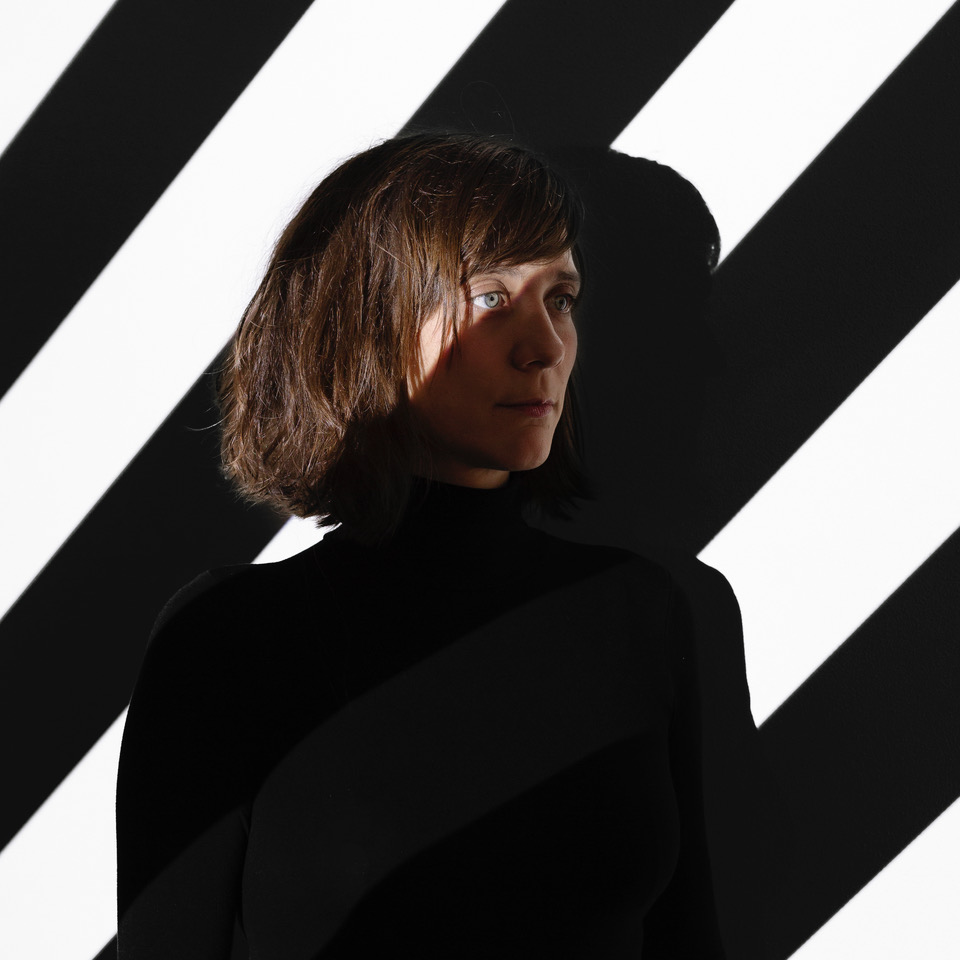
ABOUT MARTYNA WĘDZICKA-OBUCHOWICZMartyna Wędzicka-Obuchowicz is a Polish graphic designer based in Gdańsk, known for a distinctive style built on chance, human error, and the deconstruction of typography and image. She is a member of Alliance Graphique Internationale (AGI) since 2023, a two-time winner of the Polish Graphic Design Awards, and a lecturer and speaker. She graduated from the Academy of Fine Arts in Gdańsk.
Tune in wherever you get your podcasts /
Tune in wherever you get your podcasts /



Episode Description
Most graphic designers spend their careers trying to make things that work. Clean grids, clear hierarchy, no errors. Martyna Wędzicka spent a few years doing exactly that, running a studio in Poland, building visual identities for startups and commercial brands. And then one day she realised what she actually wanted to do was the opposite.
“I really wanted to destroy something,” she told me. “That was my main goal. To destroy something.”
It’s not the sort of thing you expect to hear from someone who is now a member of Alliance Graphique Internationale, the most selective gathering of graphic designers in the world. But it’s the most honest description of her work I’ve heard, and once she explained it, the whole of her style made sense.
Martyna is a graphic designer from Gdańsk. She’s a two-time winner of the Polish Graphic Design Awards, an AGI member since 2023, a lecturer, a speaker, and one of the most recognisable poster designers working in Poland today. Her work is built on chance, human error, and the deliberate deconstruction of the things most designers are taught to keep tidy. This conversation was about how she got there, why it took longer than anyone wants it to, and why she made mistakes the whole point.
Making a style out of mistakes
The design world treats mistakes as failures. A misregistration, a glitch, a broken letterform — these are the things you fix before the client sees them. Martyna looked at that assumption and decided to turn it inside out.
“Mistakes are perceived in the graphic design world as something bad, as something unprofessional,” she said. “And I was thinking that maybe I can reverse this approach a little, and think that mistakes can be a style.”
The catch, and the part that makes her work hers rather than just chaos, is the next sentence. “Of course, you need to organise the mistakes as well.” That’s the whole craft in one line. Anyone can make a mess. The skill is in arranging the mess so that it reads as deliberate, so that the error becomes the point rather than the problem. She’s spent years developing exactly that, building a body of work around strong contrasts, geometric shapes, and the controlled deconstruction of type and image.
I told her that her style is one of the most distinctive I’ve come across. If I saw one of her posters in the wild, with no name attached, I’d know it was hers. She found that funny, because for most of her life she didn’t think she was the kind of designer who could have a recognisable style at all.
“In ten years, you’ll discover your style”
There’s a belief, especially among younger designers, that finding your style is a fast process. A breakthrough. A weekend of experimenting and suddenly you know who you are. Martyna spends a lot of her teaching life gently dismantling that idea.
“They think discovering your style is like a brilliant idea,” she said. “Like, okay, now I’m discovering my style, and they spend a few hours and discover themselves. It doesn’t work like that. It’s not that easy.”
She tells her students the truth, which is that they’re twenty-something, so they’ll probably find their style in about ten years. “And they always have such sad faces after,” she said, laughing. It sounds harsh until you sit with it. The reason there aren’t many world-recognised designers at twenty-two is that style isn’t a decision you make, it’s a residue that builds up over time, through hundreds of projects and a lot of mistakes, good and bad.
She thinks about style as water. Fluid, flexible, moving from one form to the next. Her old work and her new work look cohesive but never identical, because she connects each new idea to the last one rather than starting fresh. The throughline isn’t a fixed look. It’s her.
Leaving the studio to do the work
Before she was self-employed, Martyna co-founded a studio with two partners. On paper it was the comfortable choice. Shared responsibilities, a small team, steady clients, a predictable schedule, money coming in. The problem was what it turned her into.
“I was more like a project manager at that time,” she said. They were young, around twenty-five, fresh out of the Academy of Fine Arts in Gdańsk, and they knew almost nothing about running a business, so they figured it out as they went. Which meant Martyna, who had so much creativity she wanted to share, spent her days on paperwork and scheduling instead of design.
This is where she and I found a lot of common ground. I ran my own agency for years and ended up doing exactly the same thing, drowning in management and admin, slowly getting further away from the reason I’d started in the first place. Her advice to anyone thinking of opening a studio is short and hard-won. “Please, hire a proper project manager. That’s my only tip.”
She left after four years. Eight years later, self-employed and free to design, she’s clear that it was the right call. But she’s also honest about the cost. The thing she misses isn’t the structure or the income. It’s the people. In a studio, you have colleagues to give you feedback, to talk through a project, to tell you when something isn’t working. On your own, you decide everything yourself. The studio ended, but the friendships didn’t, which tells you what kind of place it really was.
Not Western enough, which turned out to be the point
For a while, Martyna carried a quiet worry that a lot of designers from Central and Eastern Europe will recognise. The sense that she wasn’t cool enough, wasn’t Western enough, wasn’t quite in the room where design happens.
“Then I realised that not being West enough is a good thing,” she said. “Because I’m something in between.”
She has the Western perspective, she sees what designers in Western Europe and the States are making. But she also has the other half, the Eastern European training, the deep grounding in art history and the structural, almost Swiss approach to building a system. Polish designers, she argues, are the perfect combination of the two. They can build a rigorous visual identity and then run it through the lens of art history and politics, folding two ways of seeing into one piece of work. What once felt like a disadvantage became the thing that makes her work impossible to mistake for anyone else’s.
A Polish name, on purpose
When Martyna married, she had a decision to make about her name. She’d already built her career as Wędzicka, her family name, so she kept it professionally rather than switching. She also chose to keep it Polish rather than inventing a neutral, easy-to-pronounce studio name, even though Wędzicka is genuinely difficult for people outside Poland to say. She removed the diacritic to help a little, but the name stayed Polish on purpose.
“I’m a really proud Polish girl,” she said. “And I think now it’s a strength, that I have a Polish name and I didn’t make up a fake studio name.”
That pride runs deeper than her own brand. Poland gave the world the Polish School of Posters fifty years ago, a body of work designers everywhere still know and admire. But Martyna feels the last twenty to forty years created a gap, a lack of communication between Poland and the rest of the world, partly down to political history. So she’s made it part of her job to close it. She uses her Instagram audience, around sixty thousand people built organically over a decade, with roughly seventy percent of them abroad, to share other Polish designers’ work. She doesn’t see it as a favour. She sees it as a responsibility.
Weird in the best way
I asked her what she was like as a kid, and the picture she painted explains everything that came after. An only child in a small Polish village, she spent whole days in her room making things, with scissors and paper and paint and whatever else was around. When she was five, her dad arranged her first exhibition on the floor of her grandmother’s kitchen, twenty-something A4 paintings laid out across the tiles. She still has the video. “He said, this is the very first exhibition of Martyna Wędzicka.”
She was, in her own words, a weirdo, but in a good way, and her parents, neither of whom had an art degree, were entirely supportive. That mattered, because in 1990s Poland, just after the country became a democracy, being called “such an artist” was not a compliment. It meant disorganised, unable to function in society, strange. The culture has changed since, but she grew up understanding that her weirdness was something to manage rather than celebrate.
Now she thinks it’s the source of everything. “People who are in the creative industry feel a little bit weird, they’re weirdos, they’re different from the mainstream,” she said. “I think we need to go with this weird feeling with all our hearts. This is where the style is born.”
That’s the thing that stays with me from this conversation. The destruction, the mistakes, the chaos she organises so carefully — none of it is nihilism. It’s the opposite. It’s a person who loves the work so much she’s willing to keep breaking it open to find out what else it can be.
Martyna Wędzicka-Obuchowicz is a Polish graphic designer based in Gdańsk, known for a distinctive style built on chance, human error, and the deconstruction of typography and image. She is a member of Alliance Graphique Internationale (AGI) since 2023, a two-time winner of the Polish Graphic Design Awards, and a lecturer and speaker. She graduated from the Academy of Fine Arts in Gdańsk.
Her style is built on “organising mistakes” — deliberately deconstructing graphic elements, photographs, and typography, and arranging the results so that chance and error read as intentional. Her recent work is dominated by strong contrasts and geometric shapes, much of it in poster form. She describes her style as fluid, like water, evolving from one project to the next while staying recognisably hers.
Martyna’s answer is that it takes years, not hours. She tells her students that they’ll likely discover their style in about ten years, not over a weekend. In her view, style isn’t a decision you make but something that builds up over time through hundreds of projects and a willingness to make mistakes. There’s no shortcut.
She co-founded a studio with two partners straight out of university, but found herself acting as a project manager, buried in paperwork and scheduling instead of designing. After four years she left to go self-employed so she could focus on the creative work. Her advice to anyone running a studio is to hire a proper project manager so the founders can keep designing.
The Polish School of Posters refers to a celebrated movement in Polish graphic design from roughly fifty years ago, recognised internationally for its expressive, art-led approach to poster design. Martyna sees it as proof of Poland’s design heritage and part of why she’s on a mission to make the current generation of Polish designers more visible globally.
She had already built her career under her family name, Wędzicka, so she kept it professionally rather than switching after marriage or inventing a neutral studio name. She removed the diacritic to make it slightly easier to pronounce internationally, but kept the name Polish on purpose — both as a point of personal pride and as part of her wider mission to make Polish design more visible.
If you liked this episode, listen to...
Marta Cerdà Alimbau (S02/E26) — another European designer with an unmistakable, art-led personal style and a deep relationship with craft.
This is one of the most honest and funny conversations of the season. Marta talks about creating that Vogue Spain cover in the middle of COVID, the hidden arrow she stumbled on after hundreds of attempts at the Nike logo, and the four months she spent riding out the pandemic in a farmhouse with bats, eagles, and rats while paying two rents across two countries. She studied psychology before she ever studied design, and it shows in how she thinks about the work.