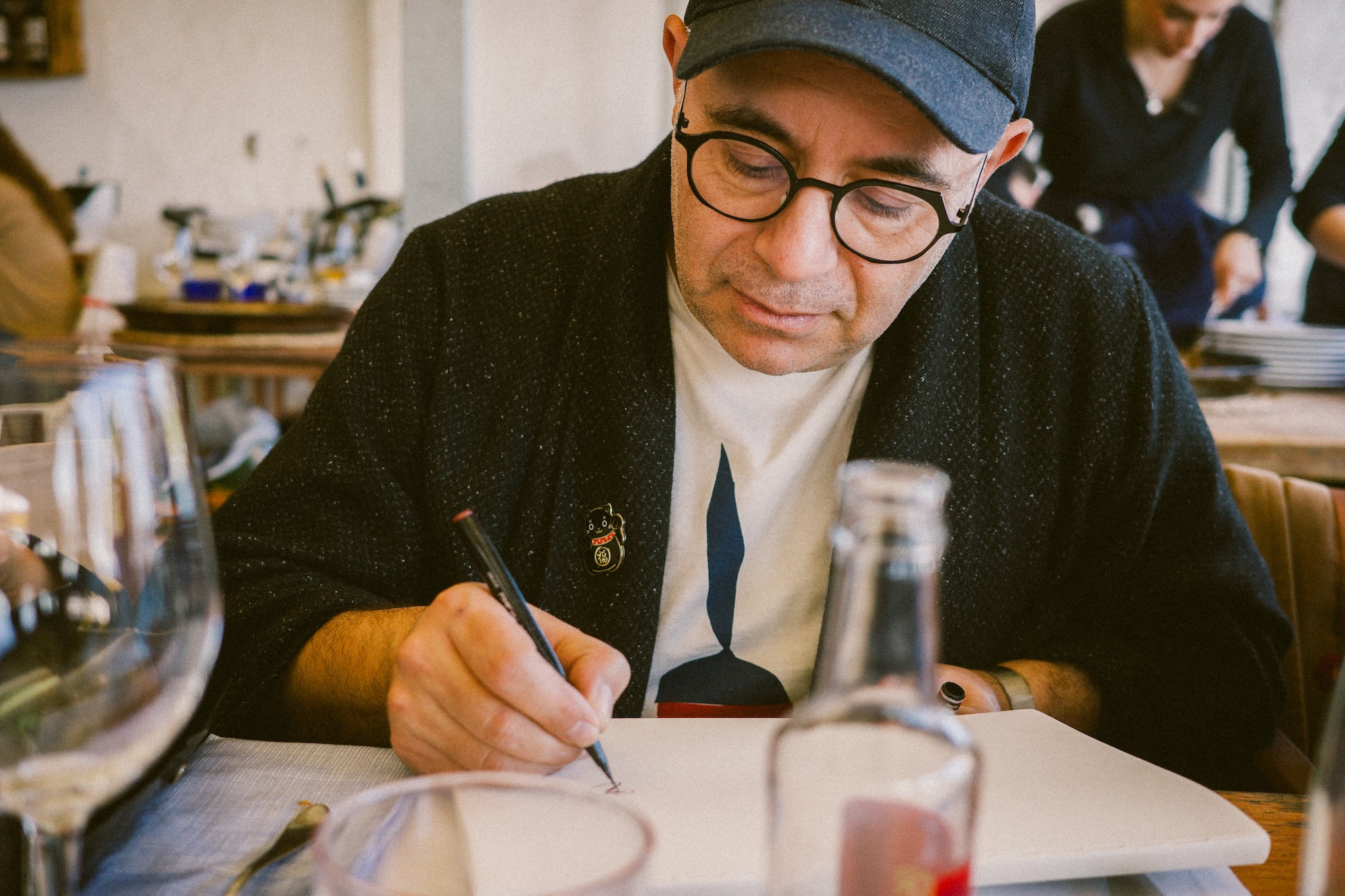
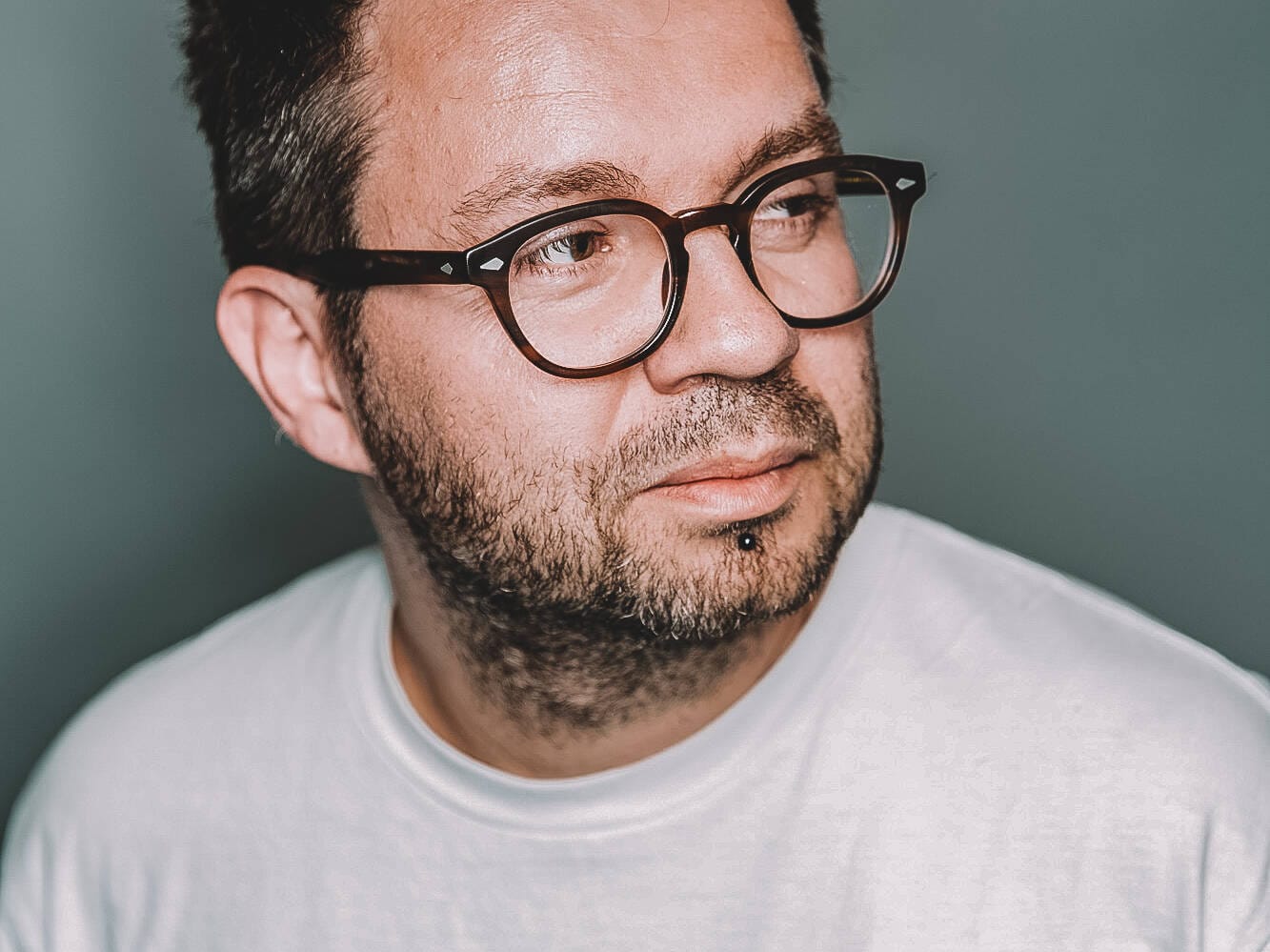
ABOUT KRISTOF DEVOSKristof Devos is a Belgian illustrator, children's book author, and art teacher based in a small town in rural Belgium. He has written and illustrated multiple children's books, designs watches for the London brand Mr Jones Watches, and teaches art to teenagers at the Academy of Fine Arts in Bruges. His surname, Devos, means "the fox" in Dutch.
Tune in wherever you get your podcasts /
Tune in wherever you get your podcasts /



Episode Description
Kristof Devos answered the call from his studio in a small town in rural Belgium, with a cat wandering in and out and a daughter’s eighth birthday party happening that same afternoon. He’d slept about five hours. So had I. It felt like the right way to start a conversation about slowing down: two tired milenials, a cup of tea on his side, talking about a life built deliberately around doing less.
Kristof is an illustrator, a children’s book author, a watch designer for the cult London brand Mr Jones Watches, and an art teacher. For tax purposes he has two jobs. For himself, he says, it’s all one job. One day he’s in his studio drawing. The next he cycles forty minutes to Bruges to teach sixteen to nineteen-year-olds at the Academy of Fine Arts. The drawing feeds the teaching, the teaching feeds the drawing, and somehow the whole thing holds together.
This is one of those episodes that stays gentle the whole way through and still manages to land somewhere deep. We talked about a watch that tells you to slow down, a car crash that reshaped his entire idea of a life worth living, and why he’d rather write a long newsletter that takes fifteen minutes to read than chase likes on a platform he’s come to genuinely distrust.
A perfectly useless afternoon
The phrase that anchors Kristof’s whole sensibility came from his first watch design for Mr Jones.
He’d been following the brand for years, too nervous to reach out. Then in 2019 he won a couple of illustration awards, and that gave him what he called a ten-minute window of confidence. In those ten minutes he fired off an email. Mr Jones replied, told him to try a design, and a day or two before a trip to Bulgaria with his wife and friends, Kristof printed empty watch faces into his sketchbook and started drawing on the plane.
He drew two watches on that flight. The first was called A Perfectly Useless Afternoon. A figure floating in a round pool, their foot pointing to the hour, a little rubber duck circling to mark the minutes. The pool tiles carry the numbers. It’s a watch about doing nothing, and it became one of the fastest releases Mr Jones had ever made.
The idea behind it is quietly radical. You usually check your watch when you’re in a hurry. This one tells you the opposite. Slow down. Enjoy the moment. Do nothing. As Kristof put it, that’s probably why it connected with so many people.
The second watch from that same plane ride featured a figure lying flat on his back in a forest, looking up. That figure was later replaced by a fox, because Devos means “the fox” in Dutch. Small detail, very him.
Leaving the city, slowly
Kristof studied graphic design and typography, then worked as an art director in agencies around Bruges. He was good at it. He even liked it. But the hours were brutal. He’d promise to be home by seven and walk in at one in the morning, sleep, get up at six, and do it again. Home was just the place he slept.
He’d actually landed a children’s book deal early on, while still art directing. The publisher liked his first picture book and asked for changes. But the day job left no room, and he let the deal slip. For a while he assumed that was it. He’d be an art director for life.
He moved out to a small town nearly twenty years ago, while still commuting into the city. The slower life came first. The slower work took longer to catch up.
The crash, and the book that came from it
The turn, when it came, came hard.
In his mid-twenties Kristof was in a serious car crash. His friend Tine died in it. He spoke about her carefully, and I want to hold that same care here. What he described wasn’t just grief. It was a complete reordering of what he valued. When he went back to work a few weeks later and found himself making adverts to sell more umbrellas for a client who thought umbrellas were the most important thing in the world, something broke open. He couldn’t keep doing it.
It took him another five years to act on it. But eventually he made a book. Not about the crash directly. A story about a brother who lost his sister. His first attempt at writing it himself came out pitch black, unsuitable for children or adults, so he took it to a Dutch writer he admired. They met in Amsterdam, she found the words he couldn’t, and he started drawing. He made labour-intensive silk screens, then redrew the whole thing in ballpoint pen almost by accident, and the ballpoint version was the one everyone loved. That became his first published book.
He still carries Tina with him. With every drawing, every book, he says he feels grateful to be here and grateful to her. He wants to make something good out of a bad thing. That’s not a tidy lesson. It’s just how he lives now.
When I asked how much the experience changed him, he said something I keep returning to: the world is hard, and one of the toughest things you can be in it today is vulnerable, kind, tender, and not cynical. Having kids did the same thing, he said. Cracked him open, made him soft, and he’s grateful for it.
Twelve spreads, and the weight of a childhood memory
It takes a lot of time to publish a children’s book. Most of that time isn’t drawing. The drawing is about three months. The rest is thinking, sketching, filling storyboards, and learning to love a character the way you’d love one of your own children.
A picture book gives you twelve spreads. That’s it. And he treats them as an enormous responsibility, because a children’s book can become one of the most important memories of someone’s childhood. So the question he asks himself isn’t only what to draw. It’s what to leave out. What not to draw is, he says, even more important.
He’s frank about the industry too. Roughly half the titles in major bookstores never sell a single copy. Books have a brutally short shelf life, vanishing within months. And the children’s market is flooded with cheap, flashy series with no named author or illustrator on the cover, the kind that turn up in supermarkets and petrol stations. His advice to anyone wanting in is honest to the point of bluntness: it’s really difficult, you need to make something of real value, and you shouldn’t be too pleased with your first attempt. But it’s worth it. He’s certain of that.
The new book, and working without a map
The project on his desk now is different from anything he’s made. It’s called Big Brother and Little Sister, his first book aimed at adults as much as children, built from four-panel comics about his own two kids. Two characters, four square panels, two colours plus the white of the paper. He gave himself strict restrictions and then set about pushing them as far as they’ll go.
What surprised him was watching the characters take on lives of their own. By the fourth panel they were doing things he hadn’t planned. There was life in them. It started over a Christmas holiday with friends, where he went quietly antisocial and drew the first few. He sent one a day to his newsletter list, started getting emails back from people saying they were sitting at their desks with a coffee waiting for the next one, and his publisher emailed asking to make it a book.
He’s drawing it without a storyboard, which terrifies and delights him. He doesn’t know which panel comes next. His deadline is May 2027. His students see the work in progress and give him feedback. It all mingles, the way everything in his life does.
Why he left Instagram and bet on the inbox
Like a lot of the artists I’ve spoken to this season, Kristof has more or less walked away from social media.
His newsletter is called Brief uit het Atelier — letter from the studio. He writes it for himself, for his readers, for his students. The only thing that now appears on his Instagram is an automated note pointing people to the latest newsletter, posted through a third-party tool. He doesn’t open the app. He has a DM auto-reply that apologises and asks people to email him instead, promising he’ll actually read and reply.
His reasoning is sharp. He quoted the newsletter Dense Discovery: stop calling it social media and call it what it is, an ad platform. Why would you give your privacy, or your art, to an ad platform? And he notices the difference in practice. When he used to sell a few drawings on Instagram, it took a week. When he puts them in the newsletter, the replies come so fast he has to tell people someone already beat them to it. The inbox is where the real conversation lives. You write, someone writes back, and it becomes a dialogue, the way letters between artists used to take months to cross a continent.
AI, and the gift hiding inside it
We didn’t dwell on AI for long, but Kristof had one of the more hopeful takes I’ve heard. Speaking strictly from an artist’s point of view, he thinks AI could turn out to be one of the biggest gifts artists have ever been handed, precisely because it’s making people rediscover the value of something made by a human hand.
His worry isn’t for himself. It’s for his students. He watched one feed a graphic design brief into an AI for inspiration and felt genuinely sad, because the student wasn’t stumbling anymore. And stumbling, he believes, is where the treasure is. The accidents, the tiny mistakes we keep in our work because they make it human. AI gives you the common denominator. It robs you of serendipity. He hopes that changes as his students get older.
What he hopes survives
I closed by asking what single piece of his work he’d want to survive if everything else were deleted in a hundred years. He said he doesn’t draw for tomorrow, he draws for today, so the answer would always be whatever he’s working on right now. Then he added something better. He hopes someone, somewhere, is still wearing one of his watches. Not for his ego. For the object, and the idea behind it. A mechanical watch with no battery that still works, that you can pass on to the next generation.
That’s the whole conversation, really. Make things slowly. Make them by hand. Make them good enough to outlast you. And in the meantime, give yourself a perfectly useless afternoon now and then.
Kristof designs for Mr Jones Watches, a London-based brand known for conceptual, story-driven timepieces. His first design, A Perfectly Useless Afternoon, depicts a figure floating in a pool and is built around the idea of slowing down rather than rushing. He has designed roughly five watches for the brand, several with limited and permanent-collection editions.
Kristof worked as an art director in Belgian agencies but found the hours unsustainable and the work creatively unfulfilling. A serious car crash in his twenties, in which he lost a close friend, reshaped his sense of what mattered and eventually pushed him toward illustration and children’s books, the work he’d always wanted to do.
Kristof has largely left social media, describing platforms like Instagram as ad platforms that offer little real value to artists. He builds his audience through a long-form newsletter called Brief uit het Atelier (Letter from the Studio), where he finds genuine dialogue with readers and, notably, far stronger engagement and sales than he ever got on Instagram.
His current project, Big Brother and Little Sister, is his first book aimed at adults as well as children. It’s a series of four-panel comics inspired by his own two children, using strict constraints — two characters, four panels, two colours plus the white of the paper. It’s due for release in late 2027.
It’s the title of Kristof’s first Mr Jones watch and a phrase that captures his whole philosophy. A perfectly useless afternoon is time spent doing nothing of obvious value — reading comics in the garden, slowing down, being present — which he considers genuinely worthwhile rather than wasted.
Speaking from an artist’s perspective, Kristof believes AI could become a gift to artists by making people rediscover the value of human-made work. His main concern is for young creatives who lean on AI for inspiration and lose the chance to stumble, make accidents, and develop their own voice.
If you liked this episode, listen to...
Luis Mendo (S02/E29) — Luis appeared on Kristof’s podcasts, and they share the same instinct: leaving social media behind, building through direct connection, and choosing a slower, more deliberate creative life. A natural companion listen.