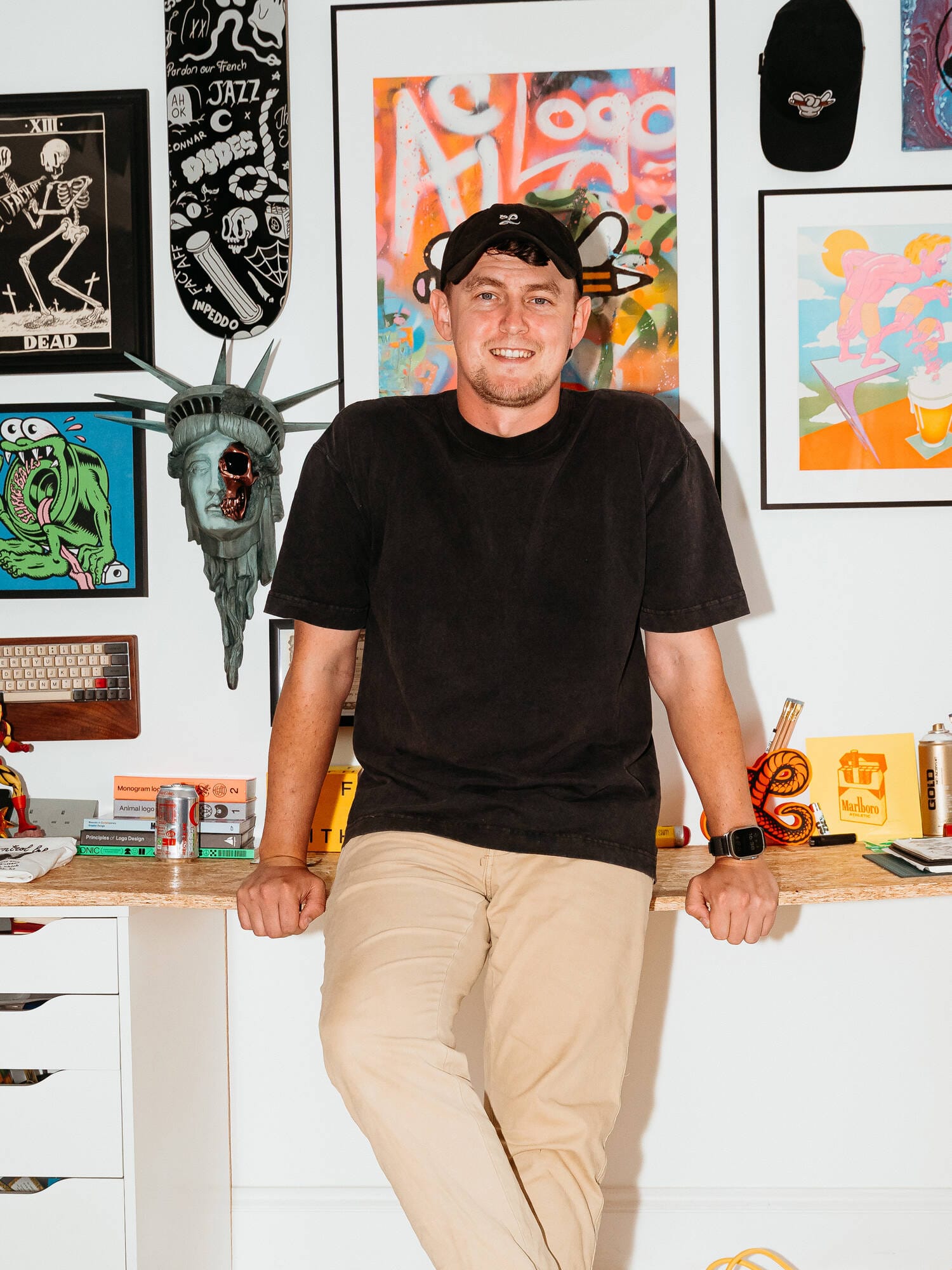
ABOUT TEMI COKERTemi Coker is a Nigerian-American artist, graphic designer, and creative director based in Dallas, Texas. He is an Adobe Creative Residency alumnus whose work has appeared in campaigns for Adobe, Apple, ESPN, AT&T, and the Oscars. He launched a home collection with Walmart in 2025. He and his wife co-run the TX Studio, a photography rental studio and community creative space in Oak Cliff, Dallas. He is the founder of the For the Arts clothing brand and an advocate for financial literacy and creative community building.
Tune in wherever you get your podcasts /
Tune in wherever you get your podcasts /



Episode Description
He wakes up at 4:30am. Two kids under two. Twenty months and three months old. He drinks his coffee, gets three hours of uninterrupted creative work in, and then the house wakes up and the day begins. This is how one of the most sought-after artists in America currently operates.
Temi Coker is a Nigerian-American artist, graphic designer, and creative director based in Dallas, Texas. His work has appeared in campaigns for Adobe, Apple, ESPN, AT&T, and most recently in a home collection for Walmart. He designed the poster for the Oscars. He was part of the Adobe Creative Residency. He went back to his old high school after graduating to teach photography and design — because he wanted the kids who looked like him to know it was possible.
This conversation is about how all of that happened. And the answer, it turns out, is both simpler and harder than most people expect.
From Lagos to Texas — The Duality That Defines Everything
Temi was born in Lagos, Nigeria. He moved to Canada at around 12 when his father — a pastor — was relocated to start a church. He spent a year there, encountered electricity that never went out (a genuine cultural shock after Nigeria’s frequent power cuts), and then moved to Texas, where he has been ever since.
He is 33. He has lived in America for more than two decades. And the tension between those two worlds — Nigerian and African-American, African and American, ancient and modern — is not incidental to his work. It is his work.
“I know what it’s like to live in both cultures. In my collection, you see this theme of duality — whether it’s colour versus texture, whether it’s texture versus form. I wanted to convey that this work can live in both homes and tell both stories.”
Growing up in Texas meant navigating a cultural gap that ran in both directions. Some African-Americans assumed Africans thought they were better than them. Some Africans didn’t understand the history of African-Americans in the US. Temi landed in the middle of it, without a clear home in either community, eventually arriving at a place of deep respect for both.
“We’re so much more alike than we are different. We do cookouts in Nigeria. We play mancala here. The same things. And so I realised that if I was going to be an artist, I wanted to make sure I brought both sides together in my work.”
Growing up in Nigeria also gave him something else: a creative relationship with limitations.
“In Nigeria, we might not have had a lot, but we always figured out how to have fun with what we had. It’s raining. We can’t go outside. My friends and I want to play football. So we found bottle caps. Sprite team and Pepsi team. A ball made from rubber bands. I love limitations because they make you think deeply.”
Biomedical Engineering — and Why He’s Glad He Left
Temi’s father is a pastor. His mother too. Both Nigerian. And in Nigeria, as he describes it, there are essentially five respectable career paths: doctor, lawyer, nurse, accountant, engineer.
So when Temi said he wanted to study music, his dad’s response was clear.
“He said, I didn’t come from Nigeria to America for you to go study music.”
Temi chose biomedical engineering — partly because he was genuinely interested in robotics and prosthetics, the idea of making someone’s life better. He got As and Bs. And then he switched to graphic design, got almost all As, and never looked back.
The lesson he took wasn’t resentment towards his parents. It was the opposite.
“I don’t fault my parents for wanting the best. That’s all they knew. But if you live your life for your parents, when your parents pass away, you’re not going to know who you really are. I was in school trying to make them happy. They were at home sleeping. I’m the one taking the test.”
His faith gave him the courage to switch. His father being a pastor made it complicated. But he made the call, committed to design, and when he graduated, went back to his old high school to teach — specifically so that other kids from his background would see what was possible.
The Adobe Residency — and Seven Years Before It
The Adobe Creative Residency is one of the most competitive creative programmes in the world. Temi applied because his wife told him he should.
“When I told her about it, she said, you should apply. I said, why would they pick me? She said, well, you have nothing to lose. If you apply and they don’t pick you, nothing changes. And if you get in, something changes.”
He submitted on a Friday or Saturday. By Tuesday or Wednesday, he had a call. But Adobe asked him to repitch — not because his first idea was bad, but because they’d seen his poster day work and wanted more of that.
“They seemed like they really wanted me. They said, can you repitch your idea? We saw what you were doing with the posters and we’re really interested to see what you’d do.”
He pitched a year of merging photography and design across four sectors: posters, music, fashion, and sports. The sports chapter took him to the San Francisco Warriors’ last game at the Oakland Arena. Floor seats. Suite access. A poster for one of the biggest moments in recent NBA history.
But here’s what most people don’t see: the Adobe Residency was Temi’s big break. And it came after seven years of putting his head down and doing the work — portraits, weddings, invitations, flyers — before anyone with a big name came knocking.
“You see where I’m at now. But you didn’t see the past 10 years of work that allowed me to get to this point.”
Put the Work You Want to Be Hired For
If there’s one piece of advice that Temi returns to throughout this conversation, it’s this: create the work you want to be hired for, and do it before anyone asks you to.
The Walmart home collection started because he made a pillow. His wife suggested his work would look beautiful on home décor. He made 50 pillows, put them online, and they sold out. Walmart reached out because they saw the pillow.
“I tell people — put the work that you want to be hired for and it’s only a matter of time. A lot of us sit down and wait for projects to come. We’re like, Nike didn’t call me today. But what have you done to make Nike interested?”
The Apple collaboration started the same way. They came to him with a piece he’d designed for fun — part of his poster day series — and said they wanted something in that vein for a campaign.
“They showed me a piece of work I designed for fun and said, we really love how you used colour and shapes here. Can you do something like that for this campaign? And I was like, okay, sure.”
Apple said no to him four or five times before the relationship took hold. He now has over 20 collaborations with them. The Oscars came from someone who had been watching his work for three years, waiting for the right opportunity.
“He told me: I’ve been watching you for the past three years. And imagine if I’d stopped making stuff.”
Financial Literacy — the Conversation Creatives Don’t Have
One of the most distinctive parts of this conversation is Temi’s willingness to talk plainly about money. Not in a vague, inspirational way — but in specific, practical terms.
He reads Profit First. He has a CPA. He has a financial advisor. He knows that when a big company pays him in February, the cheque might not arrive until May — and he has built his financial life around those gaps rather than hoping they don’t exist.
“I don’t want to be 60 and still making Instagram reels trying to get brand deals. Can you build something that lets you work because you want to, not because you need to?”
He splits his income deliberately: a percentage to taxes, a percentage to savings, a percentage to his shop’s inventory and advertising. He has also built a photography rental studio in Dallas — the TX Studio in Oak Cliff — which provides another income stream and a community space for workshops.
“At 50 or 55, I want to be in Amsterdam or Paris or Cannes, designing in the hotel room because I want to — not because I need to. That’s the goal.”
He is also candid about the gap between big-company prestige and big-company payment terms. Some pay on time. Some don’t. The ones that don’t will drain you if you’re not prepared.
“Being financially literate has helped with those gaps of payment. And it’s something we don’t talk enough about in the creative community.”
Fatherhood, the Walmart Collection, and Learning to Accept Compliments
The episode opens with Temi describing life with two kids under two — 20 months and three months. He wakes at 4:30am for three hours of uninterrupted work before the house comes alive. Some mornings his son wakes early and the window closes.
“Every day there’s a new boss, a new problem. You have to be okay with going with the flow in this season.”
He designed the Walmart home collection — throw blankets, vases, rugs, beaded pillows — with his wife as his direct inspiration. The vases came from watching her carry both pregnancies, seeing her body change while she retained a quiet strength.
“Vases are as important as the flowers. Without the vase, the flowers wouldn’t last. And I realised I’d been thinking about vases all wrong.”
When the collection launched, something rare happened. Friends who had known him before his career, people who had doubted him, people who had told him art wasn’t a real path — they all bought pieces and sent him photos. He got to see the full timeline of his life in their reactions.
“People who never thought I could do this full time. Now they’re like, okay, I understand what you’re doing. I apologize.”
He closes the conversation with something that feels like genuine resolve — a decision to get better at accepting compliments. To stop deflecting. To actually hear what people are saying when they tell him his work has changed something for them.
“I don’t want to be 60 and regret the times people complimented me and I never really took it in.”
Key Takeaways
For designers waiting to be discovered: You are not going to be discovered doing work you don’t want to do. Create the work you want to be hired for — spec work, personal projects, posters, whatever — and put it out consistently. Opportunities come to people who are visibly doing the work.
For creatives from immigrant or non-traditional backgrounds: Your culture is not a liability. It is your perspective, your colour palette, your story. The duality of living between two worlds is not confusion — it is material.
For early-career artists hearing no: Apple said no to Temi four or five times. He now has over 20 collaborations with them. The person who commissioned the Oscars poster had been watching for three years before reaching out. Keep making the work. People are watching.
For creatives ignoring the business side: Financial literacy is not the enemy of creativity. It is what keeps you creating on your own terms when you’re 50 or 60. Get a CPA, understand your numbers, build your savings, and don’t rely on big companies paying you on time.
For anyone struggling to accept compliments: This is more common than people admit. And Temi’s framing is worth sitting with: if you can’t take in the positive, you can’t fully experience the impact of what you’re making. Let it land.
Temi Coker is a Nigerian-American artist, graphic designer, and creative director based in Dallas, Texas. Born in Lagos, Nigeria, he moved to the United States at age 12. He is an Adobe Creative Residency alumnus whose work has appeared in campaigns for Adobe, Apple, ESPN, AT&T, and the Oscars, and he launched a home collection with Walmart in 2025.
Temi Coker’s central philosophy is to create the work you want to be hired for rather than waiting for commissions or opportunities. He believes that consistently putting out personal and speculative work — the kind of work that reflects what you want to do — is what attracts the right clients and opportunities. This approach led directly to his Walmart home collection and multiple Apple campaigns.
Temi Coker was part of the Adobe Creative Residency in 2018–2019, a year-long paid creative programme that gave him the resources and platform to develop his practice of merging photography and graphic design. He applied on the encouragement of his wife after seven years of independent work, and the residency became the breakthrough that accelerated his career into major brand partnerships.
Temi Coker describes duality as the central theme in his artistic practice — the tension and connection between his Nigerian heritage and his African-American experience, between African and American culture, between colour and texture, between form and surface. He uses this duality deliberately to create work that can speak to and live in both African and African-American homes and cultural contexts.
Temi Coker advises young creatives to put out the work they want to be hired for, to go above and beyond on every brief — including college assignments — and to understand that rejection is part of the process. Apple said no to him four or five times before he accumulated over 20 collaborations. He also emphasises financial literacy, encouraging creatives to understand taxes, savings, and income diversification from the earliest stages of their careers.
Temi Coker’s Walmart home collection is a range of living room products — including throw blankets, rugs, ceramic and 3D-printed vases, and beaded pillows — launched in 2025. The collection was inspired by his wife and by the theme of duality between his African heritage and African-American experience. Walmart approached him after seeing a pillow he had self-produced and sold out independently, which began with a suggestion from his wife that his work would translate beautifully to home décor.
If you liked this episode, listen to...
Elliot Jay Stocks on Books, Newsletters & Why Human Connection Is Everything
Elliot Jay Stocks (S02/E25) — on why the work you put out into the world matters, human connection in the creative industry, and building a creative life entirely on your own terms.