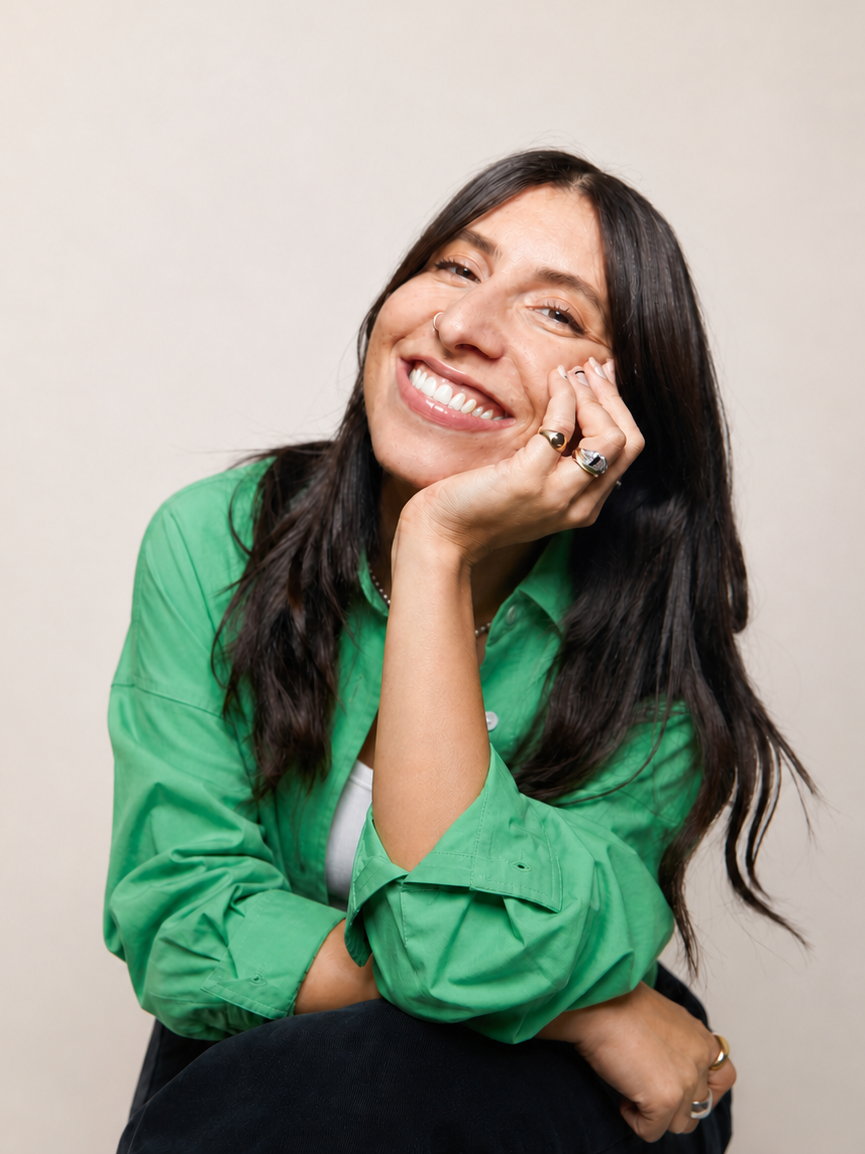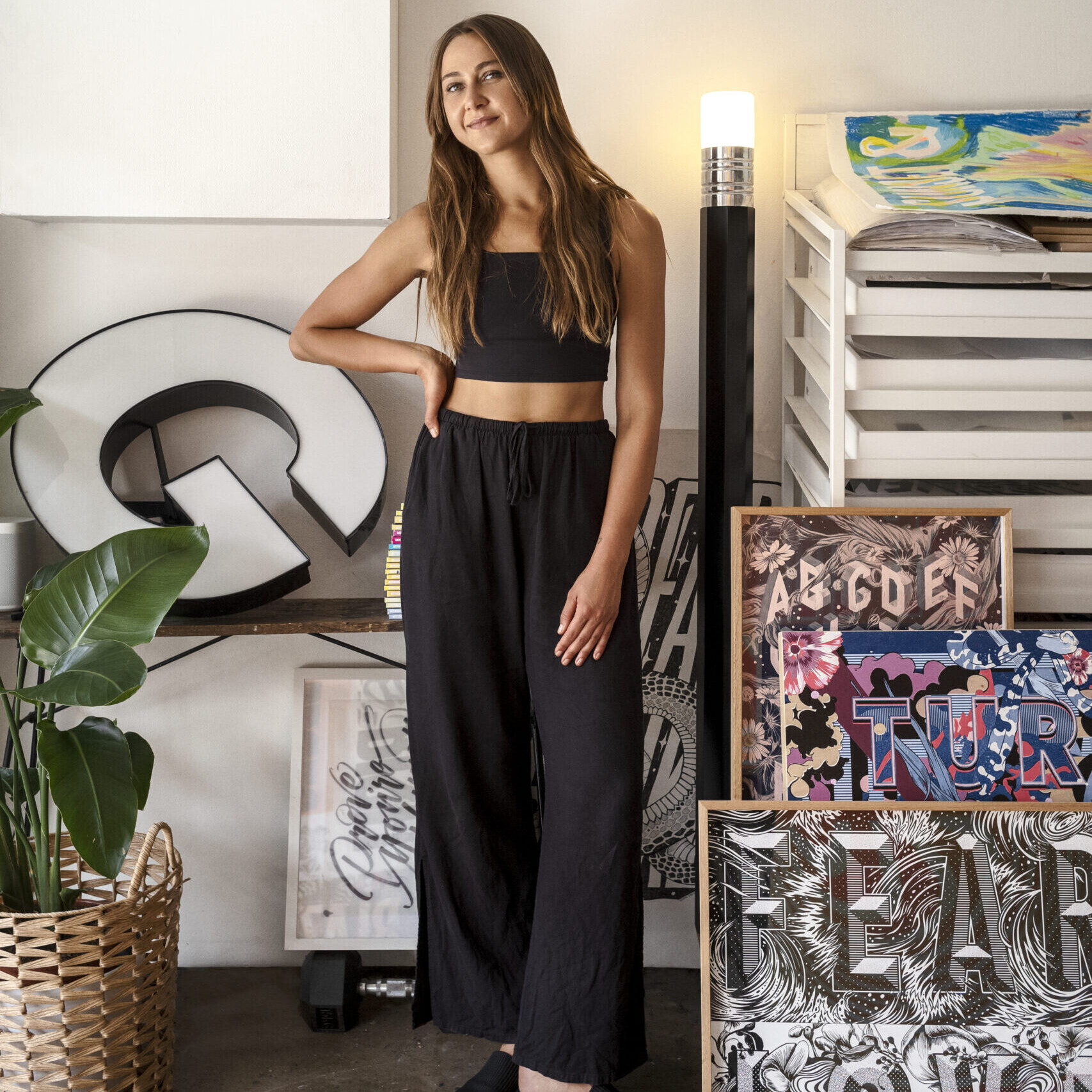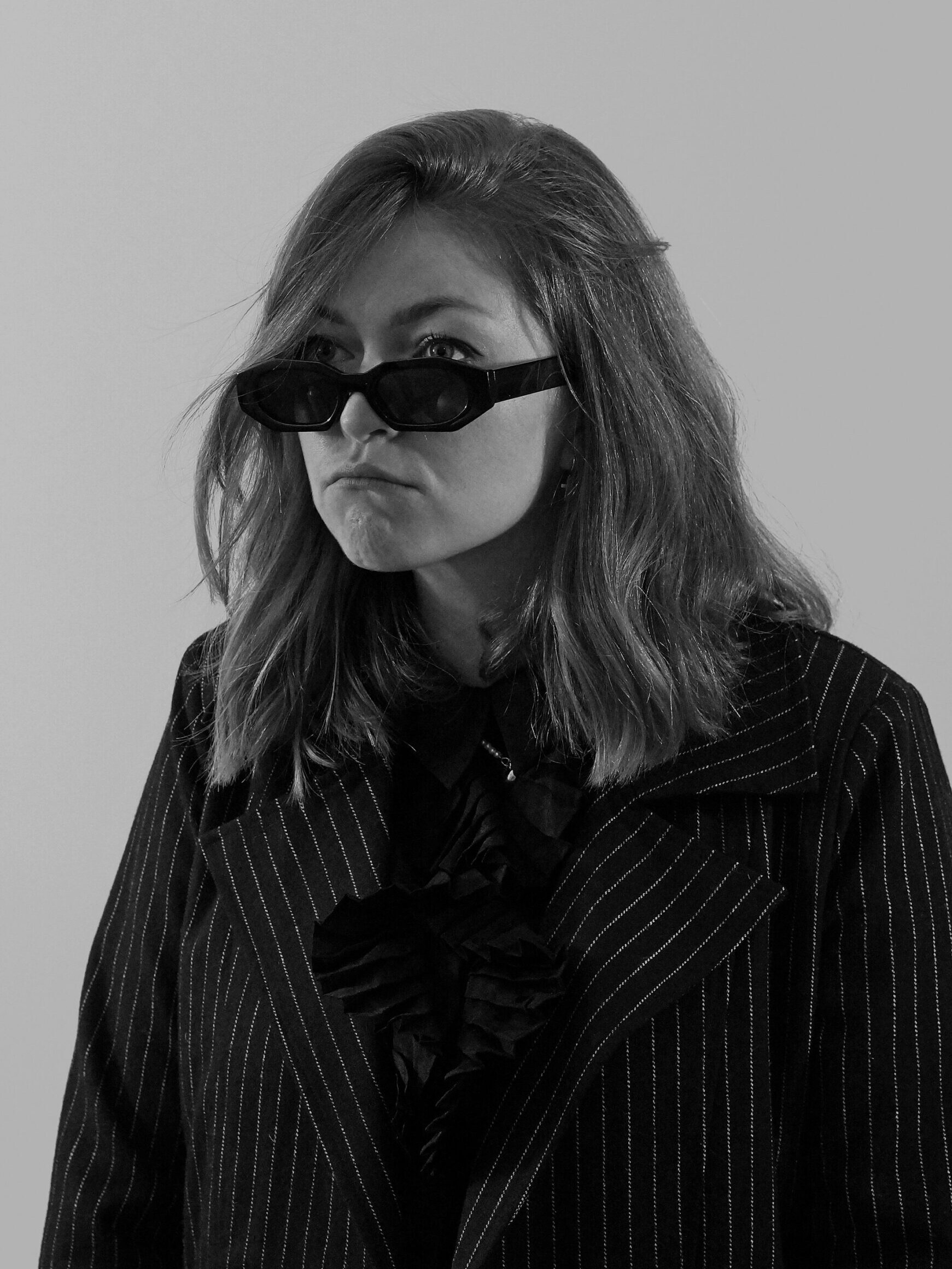
ABOUT MARTA CERDÀ ALIMBAUMarta is a Catalan graphic designer, lettering artist, and author based in Barcelona. She is a member of the Type Directors Club and AGI (Alliance Graphique Internationale). Her work includes a Vogue Spain cover, a Nike Haaland campaign, Barcelona's Christmas street light installation, and castellers and Fiesta Mayor posters for her hometown. She is the author of Surviving Design, published in a philosophy series by a Spanish editorial house. She previously lived and worked in Amsterdam and Los Angeles.
Tune in wherever you get your podcasts /
Tune in wherever you get your podcasts /



Episode Description
She designed a Vogue cover during COVID while riding her motorcycle through Barcelona without a helmet, wearing a mask, and wondering what was wrong with her motor. She made over 300 logos for a Nike campaign before landing on the one. She survived a pandemic in two countries simultaneously, paying two rents with no social security. And she wrote a book called Surviving Design — which, she insists, is actually quite optimistic.
Marta Cerdà Alimbau is a Catalan graphic designer, lettering artist, and author whose career spans Vogue covers, Nike campaigns, Barcelona Christmas street light installations, castellers posters, and one very memorable tobacco brand story involving karma, five years, and a photocopy. A member of the Type Directors Club and AGI, she is one of the most recognised designers working in Spain today — and one of the most honest people you’ll hear talk about what that actually costs.
Psychology First, Design Second
Before Marta studied design, she studied psychology — not entirely by choice. Her family, conservative and unfamiliar with what graphic design even was as a profession, pushed her towards something more conventional. She complied, for a while.
“They told me, study something normal and then do that. Because that thing you say probably won’t work.”
She didn’t finish psychology, but she didn’t leave it empty-handed either. A course called Attention and Perception — covering the physics of optics, optical illusions, and why the same colour looks different against different backgrounds — became the foundation of how she understands design to this day.
“When I started studying design, no one told us about this. Nothing related to science. And what we do also has to do with science.”
The Vogue Cover — Optimism in December 2020
Marta’s favourite project of her career is the Vogue Spain cover she created in December 2020 — widely considered one of the most striking covers the magazine has published in years.
The brief was as open as briefs get: total creative freedom. Which, as she explains, is the most difficult kind.
“Total freedom is always very tricky because you have to start from the very, very beginning.”
She spent nearly a year searching for the right direction across other projects before unlocking it. The inspiration came from Japanese minimalism — a Stedelijk Museum exhibition from 2019, the work of Ikko Tanaka — but the emotional driver came from something more immediate.
“I was so stressed in December 2020. I was riding my motorcycle in Barcelona without my helmet, with my mask on, and people were looking at me. I stopped and checked the motor — I thought something was wrong. That period was super stressful.”
And yet the cover that emerged was optimistic. Resilient. Something she couldn’t quite explain rationally, but which felt necessary.
“I wanted to do something optimistic because everything was so dramatic. I was super stressed, but I don’t know how I came up with something positive. It was like I unconsciously needed to express resilience.”
Barcelona’s Christmas Lights — and Why Generic Aesthetics Kill Cities
A few years ago, if you walked through certain small streets in Barcelona during the Christmas period, you may have seen street lights designed by Marta. The project came through an open competition for the smaller residential streets — less prestige than the big avenue commissions, but more meaning.
She worked with product designer Natran studio, drawing inspiration from the panot — the iconic hexagonal Barcelona pavement tile. By treating the tile’s petal-like shapes as modules and adding colour, they built a system that could form typography and local cultural symbols simultaneously.
“We wanted something super Barcelona that was also visible during the daylight. At night, Christmas lights look good, but they look like a tangle of metal and wires.”
The deeper motivation was about cultural identity. The creeping genericisation of cities — the same aesthetics everywhere, applicable anywhere — is something Marta feels strongly about.
“A lot of the aesthetics of cities with tourism are generic. They could be anywhere. And this, silently, it’s a little bit like killing us. You feel defeated.”
After winning the competition, the project was cancelled for a month — then reinstated. It finally appeared on Barcelona’s streets the Christmas just past.
Nike, Haaland, and 300 Logos
One of Marta’s most talked-about recent projects is a campaign for Haaland in collaboration with Nike — which she worked on alongside her husband, who was the creative director on the project at Nike.
The process was, by any measure, exhaustive.
“I don’t know how many logos I did. Maybe more than 300 until we ended up with that one. Most of them were letterings.”
The client’s final direction wasn’t lettering at all — they wanted to use their corporate font — but then became fixated on finding an Easter egg hidden within the white letterforms, the way FedEx has its famous hidden arrow.
“You can’t really force that. If it’s there, it’s there. But I was looking for arrows in my dreams.”
They found one. In the final composition, with some letters smaller and the nine larger, a subtle suggestion of an arrow appears on both the left and right sides of the mark. Their son came home from school and told his classmates. The pride was mutual.
COVID, Two Rents, and Bats in the House
The pandemic hit Marta at one of the worst possible moments. She and her husband were living in Amsterdam, preparing to move back to Barcelona. They signed the lease on their new Barcelona apartment on a Thursday. By Friday, everything had locked down.
For weeks, they paid rent on both apartments simultaneously. Her husband’s new job at Nike evaporated before his first day. She had deregistered herself from the Dutch freelance system to move, which meant no social security, no income safety net, nothing.
“We don’t have a job. We don’t have internet. We’re paying rent here. Our landlord is kicking us out. Where do you want us to go?”
When they finally made it to Barcelona in May, the apartment had no furniture — their Amsterdam belongings were still in transit — and they couldn’t go to IKEA because lockdown zone restrictions prevented it. So they went to her family’s ancient farmhouse in the countryside, empty since her parents’ divorce in 1992.
“The first day we found bats in the room, a nest of eagles in the bath, rats in the kitchen. But it was super cool. We had so much fun.”
They stayed for four months. Her son remembers it as one of the best periods of his childhood.
Surviving Design — and Why It’s Actually Optimistic
Marta’s book Surviving Design sits in a philosophy publishing series that doesn’t normally publish design books at all. The publisher made an exception because they believed the moment called for it.
“We are in a crucial moment where it’s important that we remember ourselves what design is.”
The title emerged at the end of the writing process, after the original working title fell away. She’d been trying to articulate what she found in every chapter — a struggle, a fight, a tension that never fully resolves.
“There is always a fight. And we are in a moment where we need to fight for our place here. And we have to fight for it.”
She is specifically concerned about what happens when design is split between execution, marketing, and strategy — when the person who makes the thing has no say in what the thing is meant to do.
“Form and content cannot be separated. If they are split, they only look for numbers and data. And people are not stupid. You can tell clearly when a campaign is only looking for data.”
Her argument for why designers specifically matter — rather than any other creative or commercial professional — is one of the most articulate versions of it you’ll hear:
“We have the sensibility of the artist. The craft of an artisan. The skepticism of a scientist. The sharpness of an engineer. We have a very polyhedric profile that is really needed today.”
The book is a fight for that profile. And yes, she insists, despite everything, it’s optimistic.
Comic Sans, Karma, and the Tobacco Brief
Marta’s most controversial public statement — that Comic Sans is a beautiful typeface — was made deliberately, in a newspaper aimed at general audiences, to make a specific point. Not about the typeface itself, but about context.
The framing came from a talk she attended in 2004, where type designer Vincent Connare came to Valencia and showed a slideshow of Comic Sans spotted in the wild: on police warnings, in banks, in contexts that were the precise opposite of what the font was designed for.
“I say it mostly not for the design community. I said it in that specific newspaper to make a point: it’s not about the type, it’s about how we use the type, and in what context.”
The tobacco brand story is different — and darker. Early in her career, during the toughest financial months of freelancing, an agency approached her to do a pitch for a tobacco box. Her aunt — who was like a second mother to her — had just been diagnosed with a terminal cancer. Marta did the pitch anyway.
“I was so like, it was even a pitch, but I charged for it, so it was okay. So I did it. And the pitch didn’t go well, so at least it never came out.”
Five or six years later, she walked into a tobacconist to buy cigarettes and found her illustration — photocopied and adapted — on another brand’s packaging.
“It was like life giving me a punch in the stomach. Like, don’t do this. This is karma.”
She stopped smoking in 2020. Mostly.
Key Takeaways
For designers worried about their place in an AI and data-driven world: The polyhedric profile of a designer — part artist, part artisan, part scientist, part engineer — is not a weakness or an identity crisis. It is the most valuable professional profile in a world that desperately needs people who can hold all of those things simultaneously.
For creatives navigating financial hardship: The hardest years at the beginning are not a sign that you’re in the wrong field. They are almost universal. Get through them however you can — including the projects you’re not proud of.
For designers asked to choose a label: Marta resisted the label of lettering artist or typographer even when that was most of what she was doing, because she believed a graphic designer should be a crafter across all dimensions of the discipline. There’s wisdom in not letting your tool define your identity.
For anyone going through a terrible period: Everything is going to be alright. Keep calm and keep going.
Marta Cerdà Alimbau is a Catalan graphic designer, lettering artist, and author based in Barcelona. She is a member of the Type Directors Club and AGI (Alliance Graphique Internationale), and is known for her Vogue Spain cover, a Nike Haaland campaign, and Barcelona’s Christmas street light installation. She is the author of Surviving Design.
Surviving Design is a book by Marta Cerdà Alimbau published in a philosophy series by a Spanish editorial house. It examines the fundamental tensions in graphic design — between form and content, aesthetics and strategy, craft and commerce — and argues for the irreplaceable value of the designer’s polyhedric profile in contemporary culture. Despite its title, Marta describes the book as ultimately optimistic.
The Vogue Spain cover was created in December 2020, during the peak of the pandemic. The brief offered complete creative freedom. Marta drew inspiration from Japanese minimalism — particularly the work of Ikko Tanaka — and channelled the tension between the overwhelming stress of the period and an unconscious desire to express resilience and optimism.
Marta won an open competition to design Christmas lights for Barcelona’s smaller residential streets, working with product design studio Natran. The design was inspired by the panot, Barcelona’s iconic pavement tile, using its petal-shaped elements as modular building blocks for typography and cultural symbols. The motivation was to counter generic tourism aesthetics with something authentic.
Marta Cerdà Alimbau has publicly described Comic Sans as a beautiful typeface — a deliberately provocative statement made to a general newspaper audience to make a point about context. Her argument is that no typeface is inherently bad; what matters is whether it is used in an appropriate context. The statement was inspired by a 2004 talk by Comic Sans designer Vincent Connare, who showed the typeface appearing in wildly inappropriate real-world contexts.
Marta has consistently resisted being labelled solely as a lettering artist or typographer, even during periods when lettering was her primary output. She believes a graphic designer should be a crafter across all dimensions of the discipline — part artist, part artisan, part scientist, part engineer. She sees over-specialisation as a narrowing of both identity and creative possibility.